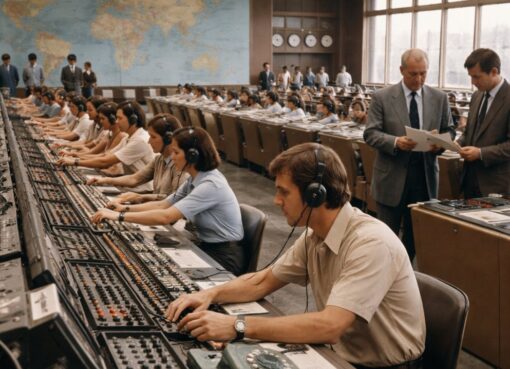
Trace the evolution of telecommunications milestones

In the tapestry of human communication, the field of telecommunications stands out as a vibrant thread connecting various epochs with transformative milestones. This journey from rudimentary signals to sophisticated digital exchanges marks a pivotal element in the story of human innovation.
Les débuts avec le télégraphe
The roots of modern telecommunications can be traced back to the invention of the electrical telegraph in the early 19th century. It was Samuel Morse, with his code, who heralded a new era of instant communication over long distances. By 1844, the first message, “What hath God wrought,” had been transmitted between Washington, D.C., and Baltimore, sowing the seeds of a communication revolution.
Le téléphone : une nouvelle dimension
If the telegraph was the harbinger, the invention of the telephone in 1876 by Alexander Graham Bell was the harbinger’s heir. The dramatic shift from text to voice communication changed everyday life and enterprise, leading to a bustling network of telephone lines that soon crisscrossed the globe. By the early 20th century, telephone service was a staple in urban centers, setting the stage for further advancements.
Les premiers pas vers la téléphonie sans fil
Marconi’s success in transmitting the first wireless signal across the Atlantic in 1901 was a landmark, opening the way to radio. This technology would later evolve into mobile telephony. The early 20th century witnessed the burgeoning of radio broadcasting, which, by the 1930s, had become a mass medium, bringing news, entertainment, and culture into homes worldwide.
L’ère des satellites et la téléphonie mobile
 Fast forward to the Space Age, and the launch of communications satellites like Telstar in 1962 redefined global connectivity. These orbiting devices allowed for instantaneous voice and data transmission across continents, making the world smaller and more connected. In parallel, the latter half of the 20th century saw the rise of mobile telephony. The 1980s brought the first generation (1G) of mobile phones, transitioning to digital 2G networks in the 1990s, which made text messaging and roaming possible.
L’internet et l’ère numérique
The advent of the Internet in the 1990s marked a watershed moment, integrating with telecommunication systems to offer a plethora of services that reshaped personal and professional domains. The Internet Protocol (IP) became the backbone of a new era, supporting a wide array of digital communications, video calls, and eventually, streaming services.
Vers la 5G et au-delà
Today, we stand on the brink of another transformative leap with the deployment of 5G networks. Offering unprecedented speeds and connectivity, 5G is set to power the Internet of Things (IoT), autonomous vehicles, and smart cities. As telecommunications continue to evolve, the boundary between virtual and physical realms blurs, promising a future where digital communication is seamless and omnipresent.
From the humble beginnings of the telegraph to the cutting-edge technology of 5G, each step in the journey of telecommunications has redefined human interaction and connectivity. The tapestry continues to be woven, with each thread contributing to a communication network that grows more robust and intricate, shaping the future of human interaction.